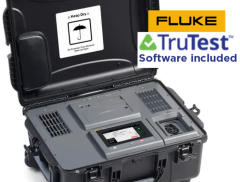
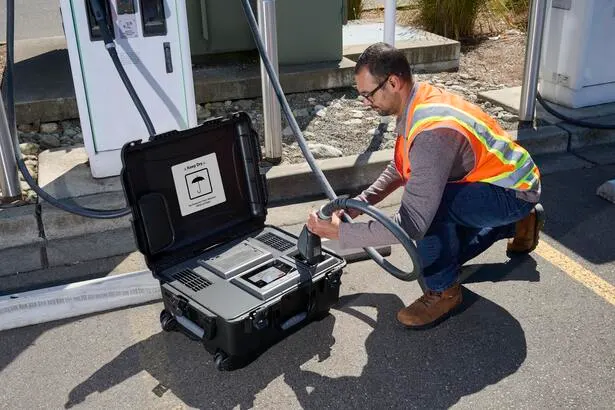
Fluke FEV500/CCS2 PRO ANALYZER CCS2 With TRUTEST Software 6120156
Product Code: FLUFEV500PRO
Usually ships 3 – 5 working days
Add To Favourites
Detailed Description
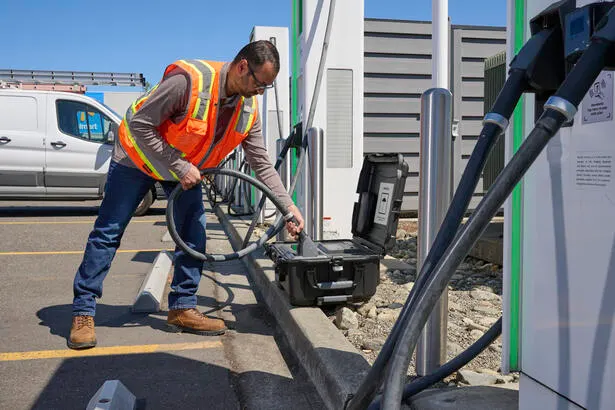
Test, validate, and document Fast DC charging stations with one portable analyzer.
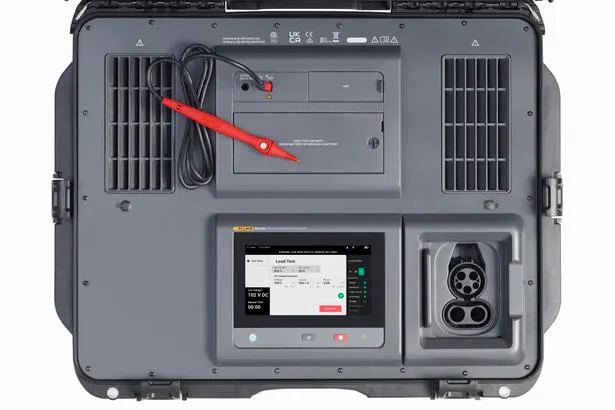
The Fluke FEV500 is a field-ready, advanced analyzer that streamlines the testing of Fast DC EV charging stations by combining essential safety and performance checks into a single device. Designed for ease of use, it simplifies the evaluation process without the need for additional test and measurement equipment, ensuring that EVSE (Electric Vehicle Supply Equipment) remains safe and operational. The FEV500 has an intuitive interface and features seamless software integration, making it easier for technicians to troubleshoot, manage data, and maintain EVSE uptime with confidence and efficiency. The FEV500 is compliant with ISO 15118 and DIN SPEC 70121 international standards for the digital communication between electric vehicles and electric vehicle supply equipment. It has been tested for compatibility with major EVSE manufacturers.
Comes Supplied With:
- FEV500 Analyzer
- TP165X remote control probe
- Li-ion Battery
- USB-C to USB-A cable
- TruTest™ Software License
ALL-IN-ONE FAST DC TESTING
Combines performance, interoperability and safety measurement features into a single, portable device, no need for multiple tools or complex setups.
BUILT-IN EV SIMULATION
Simulates real EV charging up to 2kW. No external load banks or vehicles required, enabling complete station validation anytime, anywhere.
RUGGED, FIELD-READY DESIGN FEV500
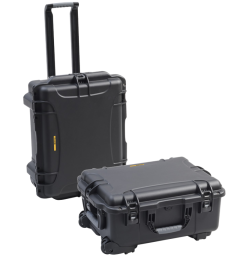
Engineered for durability and portability with integrated wheels and handle, ideal for demanding on-site testing. The battery is removable for easy airline transport.
VIEW REAL-TIME REPORTS ON THE FEV500
Seamless integration with Fluke TruTest™ software for instant documentation, compliance reporting, and actionable maintenance insights.
BATTERY-POWERED FOR TRUE MOBILITY
No wall outlet required. The battery recharges via energy harvesting during EVSE load tests for extended field use.
Key Features:
- Comprehensive Testing: Performance and safety testing combined in one device.
- EV Simulation, No External Equipment Needed: Simulates electric vehicle charging during testing, eliminating the need for additional load banks, electric vehicles or multifunction testers. Verifies charging station operability and performance by simulating a kW load to mimic real charging sessions.
- Autotest Feature: Run pre-configured test sequences with automatic execution and clear pass/fail results. No need to use other equipment or reconfigure test leads.
- User-Friendly Interface: Intuitive touchscreen display visible in bright sunlight with guided workflows and for easy operation and interpretation of results.
- CCS Connectivity: Supports CCS connectors for widespread compatibility. Available in CCS1 or CCS2 models.
- Portable and Durable: Rugged design ideal for field use, with a removable, rechargeable battery, no outlet required.
- Automatic Data Management: Tracks and stores unique EVSE and connection point IDs for streamlined asset management.
- TruTest™ Software: Facilitates documentation and reporting of results.
Performance and Safety Tests:
Communication & Performance:
- CCS Charge State Verification
- Signal Level Attenuation Characterization (SLAC)
- Low-Level Communication Testing for CCS
- Power Line Communication (PLC) Testing
- Load Testing (Voltage & Current during simulated charging)
Electrical Safety:
- Insulation Resistance (IEC 61557-2)
- Low Impedance Measurement (IEC 61557-4)
- IMD Test (Insulation Monitoring Device, IEC 61557-8)
- Residual Voltage Measurement (IEC 61851-1)
Streamline Fast DC EV Charging inspections using one integrated tool
Other EVSE test tools often only support vehicle simulation and require other test equipment to perform a full inspection. This requires reconfiguration of test leads and the need to bring multiple devices on-site. Managing multiple devices can lead to inefficiencies, increased test time and higher likelihood of human error. The FEV500 consolidates all recommended electrical inspection steps into a single portable device. Technicians can test continuity, insulation, check IMDs (insulation monitoring devices), and residual voltage all through the EVSE connector without the need to use other devices.
EVSE Validation: Independent, Precise Testing Without an EV On-Site
As electric vehicles become the norm, ensuring the reliability and performance of EV charging infrastructure is more critical than ever. Traditional validation methods often rely on the presence of an actual EV, which can limit flexibility and delay testing—especially in remote areas or during maintenance windows. The Fluke FEV500 empowers technicians with a smarter approach: it simulates an EV, enabling comprehensive testing of charging and communication protocols without needing a vehicle on-site. This independence streamlines workflows, reduces downtime, and allows for repeatable diagnostics under controlled conditions. Technicians can replicate specific charging scenarios, verify protocol compliance, and troubleshoot issues with precision—anytime, anywhere. By decoupling EVSE validation from vehicle availability, the FEV500 supports proactive infrastructure readiness for a fully electric future.
Simplify Every Step of Fast DC Charger Testing
The Fluke FEV500 streamlines Fast DC EVSE testing by combining safety, performance, and interoperability checks into one compact, field-ready tool. Its guided testing workflow walks technicians step-by-step through each protocol, ensuring consistency, confidence, and faster results, no matter what their experience level is. The FEV500 delivers EV-free validation, simulating real charging sessions and communication without needing a vehicle on-site, while error simulation verifies that safety systems respond correctly to faults. Designed for the field, it is portable, durable, and battery operated, with wheels and a handle for easy transport and no need for external power. The analyzer also consolidates multiple instruments— EV, protocol analyzer, low-ohm meter and oscilloscope —into a single device for complete non-invasive testing without opening the charger. Test data is automatically captured and transferred to TruTest™ software, eliminating manual entry and simplifying documentation for compliance and reporting. With the FEV500, technicians can test smarter, safer, and faster, anywhere the job takes them.
FLUKE Trutest Software (included)
Automated Documentation: Removes the Need for Manual Data Entry Manual data entry is a time-consuming and error-prone process that can lead to inaccuracies in test documentation, complicating maintenance records and compliance reporting. Technicians must often transcribe test results by hand from multiple test tools, which not only slows down the workflow but also increases the risk of data loss or incorrect entries. The Fluke FEV500 automates the documentation process. Test results are automatically recorded and stored within the device and can be easily transferred to TruTest™ software via USB-C for further analysis and report generation. This automation eliminates the need for manual data entry, ensuring that all test results are accurately captured and documented. It also streamlines compliance reporting and maintenance planning, providing reliable, traceable records that can be accessed and shared as needed. This not only saves time but also enhances the overall efficiency and accuracy of the testing process.
Technical Specification
| General | |
|---|---|
| Case | Rugged, wheeled hardcase |
| Dimensions | 65cm x 50.8cm x 30cm (25.6in x 20in x 11.8in) |
| Weight | 26 kg (57 lb) |
| Display | 7-inch TFT, 1024 x 600 pixels, capacitive touchscreen (operable with PPE gloves). Extra bright display, readable even in sunlight, with up to 1,700 cd/m² brightness adjustment via ambient light sensor. |
| Interface | Buttons: On/Off, Backlight, Pause Test LEDs: Power supply, Battery status, Charging |
| Power | |
| Battery | Lithium-ion; 10.8 V, 6.8 Ah, 73.44 Wh (customer replaceable) |
| Runtime | 10 hours (battery is charged during the test) |
| Charging Time | Typically 3 hours with USB-C PD 65 W charger |
| Backup Duration | Up to 6 months |
| Interfaces | |
| Wireless Communication | Integrated Wi-Fi (802.11b/g/n) and Bluetooth 5.2 module TX/RX Frequency Range: 2400 MHz to 2483.5 MHz Transmit Operating Power: < 100mW Encryption: WPA2-AES (WiFi), AES-CCM (Bluetooth) (Activation subject to firmware support. Refer to release notes for availability.) |
| USB-C | USB 2.0 high-speed for data download to PC software TruTest and calibration Charging battery with USB-C power adapter PD 2.0 or higher with 9V 1.8 A USB-C flash drive support for firmware updates Max supply current: 900 mA |
| GNSS | Global navigation satellite receiver with internal antenna for time synchronisation |
| Security | 11 A (not replaceable by the customer) |
| Fluke Warranty | Main unit: 2 years; Battery and accessories: 1 year |
| Environmental | |
| Operating Temperature | -20 °C to +50 °C (-4 °F to +122 °F) |
| Battery Charging Temperature | 0 °C to +45 °C (32 °F to +113 °F) |
| Storage Temperature | -20 °C to +60 °C (-4 °F to +140 °F) Recommended: 0 °C to +30 °C |
| Operating Humidity | ≤100% up to 30°C; 55% at 40°C; 35% at 50°C |
| Operating Altitude | Up to 3000 m |
| Storage Altitude | Up to 12,000 m |
| Vibrations | IEC 60721-3-3/3M2 |
| Drop Test | 0.5 m (optical defects possible) |
| Protection Class (Lid Closed) | IP54 |
| Protection Class (Lid Open) | IP40 (protected against objects ≥1 mm) Air cooling plenum: IP20 (protected against objects ≥12.5 mm) No protection against water ingress |
| Safety Standard | IEC 61010-1, Pollution degree 2 IEC 61010-2-034 |
| Electrical | |||
|---|---|---|---|
| Auto-Test Sequence | |||
| Tests Performed | CCS Low-Level Communication and SLAC Test, Continuity Test, Insulation Resistance Test, Load Test (including Cable Check Voltage Measurement), IMD Test, Residual Voltage Test | ||
| Continuity Test (RLO) | |||
| Measurement | Test probe to the PE pin of the CCS 1/2 socket | ||
| Open-Loop Voltage | Max. 5 V | ||
| Test Current | Max. 10 A (up to 0.2 Ω) | ||
| Test Method | DC testing with alternating polarity | ||
| Live Circuit Detection | Inhibits test if test probe voltage > 60 V | ||
| Test Probe Zeroing | Select ZERO in the user interface to zero the test probe resistance | ||
| Standard | IEC61557-4 | ||
| R LO Range | Resolution | Accuracy | |
| 2 Ω | < 1Ω: 0.1mΩ ≥ 1Ω: 0.0001Ω |
≤ 20 mΩ: ± (8% + 0.8 mΩ) ≤ 200 mΩ: ± (4% + 4 mΩ) > 200 mΩ: ± (4% + 40 mΩ) |
|
| Insulation Resistance (RISO) | |||
| Measurements | Insulation resistance DC+ to PE and DC- to PE | ||
| Test Voltage | Max. EVSE voltage ≤ 500 V: 500 V +10% / -0% Max. EVSE voltage > 500 V: 1,000 V +10% / -0% |
||
| Maximum Short-Circuit Current | 2 mA | ||
| Standard | IEC61557-2 | ||
| Test Voltage | R ISO Range | Resolution | Accuracy |
| 500 V | 10 kΩ to 20 MΩ | 0.01 MΩ | ± (5% of the measured value + 2 digits) |
| 1000 V | 10 kΩ to 20 MΩ | 0.01 MΩ | ± (5% of the measured value + 2 digits) |
| CCS Communication Test – Control Pilot (CP) | |||
| Parameter | Voltage CP high, Voltage CP low, Frequency, Duty Cycle | ||
| Simulation of States | A, B, C, D, E (Simulation and Validation) | ||
| Digital Protocol | DIN SPEC 70121, ISO 15118 | ||
| Parameter | Range | Resolution | Accuracy |
| CP High, CP Low | -15 V to +15 V | 0.01 V | ± (0.4% of the measured value + 2 digits) |
| Frequency | DC, 900 to 1,100 Hz | 1 Hz | 0.1% of the measured value + 1 decimal place |
| Duty Cycle | 2 to 98% | 0.10% | + 5 places |
| SLAC | 0 dB to 20 dB | 1 dB | |
| UK Mainland | Order by 2pm for Next Day Delivery* |
|---|---|
| Under £25.00 | £4.50 |
| Over £25.00 | FREE |
| UK Highlands & Islands | Order by 2pm for Next Day Delivery* |
|---|---|
| Under £80.00 | £15.00 |
| Over £80.00 | FREE |
Related Products
-
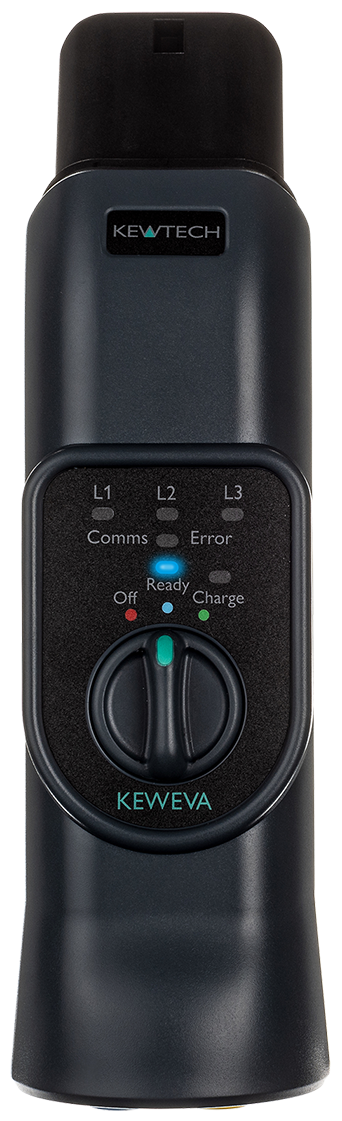
Kewtech KEWEVA EV Charge Point Testing Adapter

Price £330.00 £275.00
Code: KEWEVA
Usually ships 3 – 5 working days
-
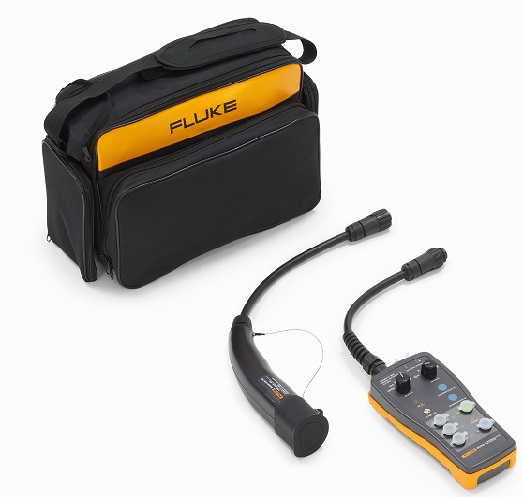
Fluke FEV300 EV Charging Station Adapter Plus Type 2 Connector 5347987

Price £538.80 £449.00
Code: FLUFEV300TY2
Usually ships 3 – 5 working days
-

Dilog DLEV1 EVSE Charge Station Adaptor Kit

Price £358.80 £299.00
Code: DILDLEV1
Usually ships 3 – 5 working days
-
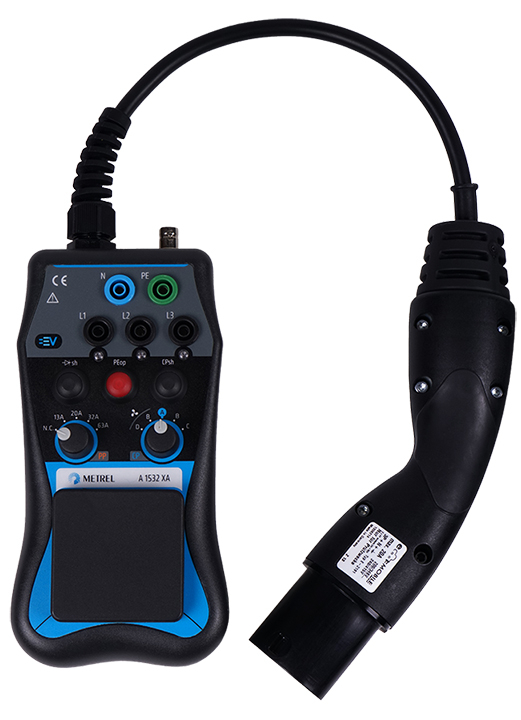
Metrel A1532 XA EVSE adapter

Price £502.74 £418.95
Code: META1532XA
Usually ships 3 – 5 working days
-

Kewtech KEWEVSE EV Charging Point Adapter
Price £402.00 £335.00
Code: KEWEVSE
Usually ships 3 – 5 working days
Product Variants
-
Fluke FEV300 EV Charging Station Adapter Plus Type 2 Connector 5347987
Price £538.80 £449.00
Code: FLUFEV300TY2
Usually ships 3 – 5 working days
-

Fluke FEV350/TY1/TY2 EV Charging Station Analyzer 5348072
Price £1902.00 £1585.00
Code: FLUFEV350TY21
Usually ships 3 – 5 working days
-

Fluke FEV350/TY2 PRO EV Charging Station Analyzer 5590693
Price £2038.80 £1699.00
Code: FLUFEV350T2P
Usually ships 3 – 5 working days
-

Fluke FEV350/KIT EV Charging Station Analyzer 5602653
Price £2638.80 £2199.00
Code: FLUFEV350KIT
Usually ships 3 – 5 working days
-
Fluke FEV500-CCS2 Fast DC Charging Station Analyzer CCS2 6008411
Price £7090.80 £5909.00
Code: FLUFEV500CCS2
Usually ships 3 – 5 working days
Recently Viewed
-
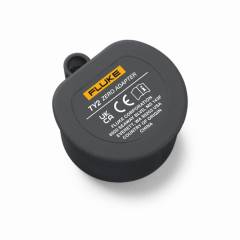
Fluke FLK-ZERO ADAPTER/TY2 Zero adapter Type 2 5590700
Price £37.79 £31.49
Code: FLUTY2ZERO
Usually ships 3 – 5 working days